SSI Traffic Solutions: Traffic Safety Products in USA and Canada
Traffic Safety Products in USA and Canada

Choosing parking cones in 2026 requires more than comparing color, price, and carton quantity. Global buyers face different climates, road standards, warehouse conditions, and delivery risks. A cone placed outside a shopping center may endure sunlight, diesel residue, rain, and repeated vehicle contact. Small details matter.
The World Health Organization reported approximately 1.19 million annual road deaths in its Global Status Report on Road Safety 2023. Parking cones cannot prevent every collision. They can improve visibility and clarify temporary boundaries when used correctly. Buyers should examine cone height, base stability, reflective performance, material flexibility, and recovery after impact. The FHWA’s Manual on Uniform Traffic Control Devices, 11th Edition, also demonstrates how visibility and temporary traffic control devices require consistent design thinking. Local requirements still differ. One product may satisfy a North American project but fail a European procurement specification.
Material choice deserves practical attention. PVC cones usually balance flexibility and cost, while rubber bases improve resistance to wind and rough surfaces. Recycled content may support sustainability goals, yet inconsistent batches can affect color and rebound. This is where supplier evidence becomes important. Request test reports, production photographs, sample approvals, and batch traceability. Do not trust attractive catalog claims alone.
This guide explains how to compare parking cones for global purchasing in 2026. It considers safety, durability, standards, customization, packaging, and total landed cost. The “best” cone is rarely the cheapest one. Sometimes, buyers also over-specify products and waste budget. A careful decision still needs review, field testing, and honest questions.
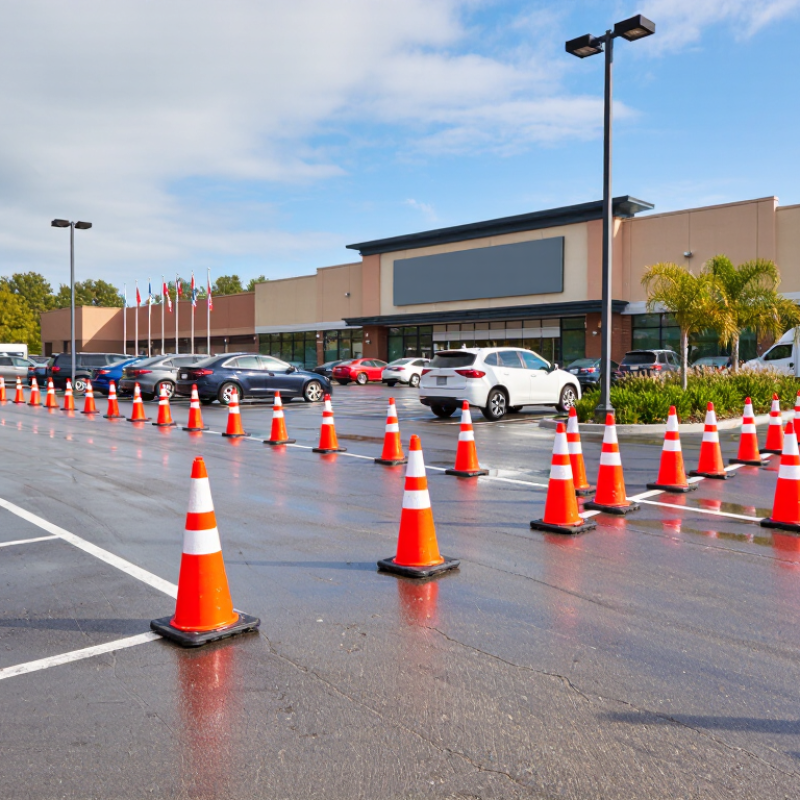
Cone height defines how early drivers notice a temporary parking restriction. MUTCD guidance uses 28 inches as a minimum for many roadway applications. For high-speed roads, the benchmark rises to 36 inches. That extra height improves visibility above sedans, pickup trucks, and uneven pavement. It also gives drivers more time to react near entrances, loading areas, and work zones. However, global buyers should not treat one standard as universal. MUTCD is a United States reference, so local authorities may require different dimensions, colors, or reflective treatments.
Tips: Match cone height to vehicle speed, sight distance, and surrounding traffic. Choose a wide rubber base for windy lots and sloped surfaces. Check the reflective band from several angles, not only directly ahead. A cone can look bright in a warehouse but appear dull under rain or headlights. Confirm measured height, base weight, material flexibility, and temperature performance with the supplier. Request test samples before ordering at scale.
I have found that “heavy-duty” descriptions can be vague. Ask for actual weights and tolerance ranges. A 28-inch cone may satisfy a basic requirement but still disappear behind a large vehicle. A 36-inch cone may improve exposure, yet it needs stable placement and suitable storage space. This is where buying decisions become less tidy. Review the latest local guidance, road speed, and installation conditions before selecting a final specification.
Global buyers should treat compliance as a selection filter, not a decorative label. The U.S. MUTCD 11th Edition generally requires traffic cones to be at least 28 inches tall. Higher-speed roads may require 36-inch cones and stronger visibility features. Check the exact road classification before ordering. A small car park and a motorway shoulder do not need identical products.
EN 13422 focuses on cone dimensions, stability, color, retroreflection, and performance testing. Ask suppliers for current test evidence, not only a printed standard number. European requirements can vary with cone class, test method, and national implementation. That detail is easy to miss. In Australia and New Zealand, AS/NZS 1906.1 mainly addresses retroreflective materials. It should be reviewed with the relevant traffic-control and roadwork requirements, rather than treated as a complete cone specification.
Visibility deserves measurable attention. The World Health Organization’s Global Status Report on Road Safety 2023 estimates 1.19 million annual road deaths worldwide. Roadside visibility cannot solve every risk, but poor contrast creates avoidable confusion. Select fluorescent orange or another locally accepted color, reflective bands with documented photometric results, and a weighted base for windy sites. FHWA guidance also emphasizes daytime and nighttime conspicuity in temporary traffic control. In practice, certificates may be incomplete, translated poorly, or outdated. I would sample-test cones after heat, rain, and repeated vehicle contact. A cone that passes inspection on day one may fail after months outdoors.
How to Choose Parking Cones for Global Buyers in 2026?
Visibility should be specified, not guessed from a bright daytime sample. For reflective cone collars, ask for retroreflection data measured under ASTM D4956 methods. The key value is expressed in cd/lx/m², showing how much light returns toward a driver.
A qualified laboratory measures the sheeting at defined entrance and observation angles. Those angles matter. A cone may perform strongly at one geometry but appear weaker from a wide approach. Request the test angle, color, sheeting class, conditioning method, and measurement date. Without these details, a high number can mislead purchasing teams.
Check the certificate against production samples, not only a supplier’s catalog image. Inspect collars under vehicle headlights from several distances. Look for even brightness, clean edges, and secure bonding around the cone. ASTM D4956 is a useful technical benchmark, but it does not automatically prove compliance in every country. Local road-use requirements may differ.
Weathering deserves attention. Dust, rain, bending, and ultraviolet exposure can reduce performance over time. A realistic specification should include initial and retained cd/lx/m² values after conditioning. This is where buyers sometimes compromise too quickly. Lower cost can become poor night visibility, especially near loading areas or temporary lane changes. I would also record cone color, base stability, and collar dimensions, because retroreflection cannot correct an unstable cone.
Specify visibility by measuring the retroreflection coefficient in cd/lx/m². The chart compares representative minimum white-sheeting values at the ASTM D4956 reference geometry of 0.2° observation angle and −4° entrance angle.
Higher RA values indicate stronger return of light toward the driver. ASTM D4956 requirements vary by sheeting type, color, observation angle, entrance angle, and standard revision; confirm the applicable specification with an accredited laboratory before purchasing.
For global buyers in 2026, a parking cone should be judged by testing, not color or catalog photos. In field inspections, I start with the base. Place each cone on clean, level concrete. Record its weight, footprint, and tilt angle. Then apply a sideways push at waist height. A stable cone should resist sliding and return upright after release. Do not test only once. Three trials reveal inconsistent molding or hidden flex. Simple data beats confident guesses.
Impact recovery needs a controlled check. Strike the cone with a weighted rubber block at several heights. Use the same speed each time. Watch the body, collar, reflective area, and base connection. A good cone bends without cracking, separating, or staying folded. Leave it for ten minutes, then inspect fine splits around the lower seam. I once accepted a sample that recovered quickly, but its base warped after repeated hits. That was a useful failure.
Temperature changes expose weaker materials. Store samples at 0°C and 50°C for at least 24 hours before testing. Move them directly to a hard outdoor surface. Check brittleness in the cold and softening in the heat. Measure height, base flatness, and rebound again. Record photos, temperatures, and test counts for each shipment. A supplier’s test sheet helps, but independent checks remain essential. Conditions vary. Your first protocol may need revision after rain, dust, or rough pavement.
How to Choose Parking Cones for Global Buyers in 2026?
A reliable cone starts with a controlled factory process, not a low quotation. ISO’s 2022 survey recorded more than 1.2 million ISO 9001 certificates worldwide. Certification shows process discipline, but it does not guarantee cone height, color stability, or base weight. Ask for the certificate scope, recent audit status, and batch records. Then inspect samples under daylight. Check rebound, surface cracks, reflective bands, and carton compression.
Use ISO 2859-1 for acceptance sampling. Do not choose an AQL number blindly. Match the inspection level and defect class to road risk. A buyer may define missing reflective tape as critical, while minor molding marks remain acceptable. The standard supports consistency, but judgment is still required. I have seen attractive samples hide unstable production lots.
MOQ changes the real price. A larger order may reduce unit cost, yet increase storage and cash pressure. Freight matters too. UNCTAD reports that maritime shipping carries over 80% of global merchandise trade by volume. Compare ocean, rail, and truck options by delivered cost, transit time, insurance, duties, and damage allowance. Calculate TCO per usable cone, not per factory unit. Include testing, spare stock, relabeling, and disposal. A spreadsheet can lie. Recheck currency, fuel surcharges, and seasonal congestion before approval.